Guide to Russia  
russian geography
 GUIDE HOME   HISTORY   GEOGRAPHY   CULTURE   TRAVEL   EDUCATION   
 
Russian Geography
Map of Russia
Russian Cities
Chernobyl Shadow


  Home » Russian Cities

 
Google

Web GuideToRussia.com

Russian Cities

MOSCOW

Moscow is now over 850 years old. For the first time it appeared in the chronicle under 1147 during the reign of Russian prince Yuri Dolgoruky. And in the second half of the 15th century Moscow became the capital of Russian state.
Kremlin is a historical center of Moscow, one of the most beautiful architectural ensembles of the city. The clock on the Kremlin tower facing the Red square are symbolic to Russians as they start every New Year in the country. Kremlin Wall with its 20 towers encircles beautiful cathedrals Blagoveshchensky, Uspensky and Arkhangelsky, Granovitaya Chamber, Bell Tower "Ivan the Great", palaces, chambers, museums (including well-known Armory Chamber), enormous "Tsar-Cannon" and "Tsar-Bell".
Red Square is the main square of the city. It is famous for imposing reviews, Lenin's Mausoleum, the cemetery with the graves of statesmen buried during the Soviet period, incomparable St. Bassil's Cathedral built during the reign of Ivan the 4th Terrible, buildings of the Historical Museum and the State Supermarket (GUM).
Zariadye - Varvarka street. The outdoor Architectural Museum is situated here, the ensemble of Znamensky Monastery (17century), the English Court (15 -17century), the part of Kitaygorod Wall.
In the Pushkin Museum of Fine Arts there is the Russia's second largest (after the Hermitage in St. Petersburg) collection of foreign art from ancient times and up to now.
The Andrei Rubliov Ancient Art Museum is the depository of the unique pieces of Ancient Russia icon painters.
In the Tretyakov Gallery one may enjoy the largest collection of the native fine arts.
You can't tell that you've really seen Moscow if you haven't visited some of the magnificent convents and monasteries such as Novodevichy Convent (XVI-XVII c.), St. Daniil Monastery (the Residence of Moscow Patriarch), the cherished village Kolomenskoye (the Ascension Temple of 1532, the Tsar Peter's the First Cottage, collection of Russian tiles).
Streets Varvarka and Myasnitskaya with "Russian baroque" buildings which are famous all over the world, Arbat street (so called coroner vessel of the country) which still remembers Krymsky Khan and Napoleon, the great Pushkin, Skryabin and Denis Davydov.

ST.PETERSBURG

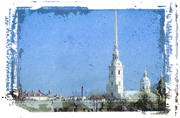
On May 27, 1703, after Russian troops had seized the strategically important Nienschantz Fortress on Zayachy Island (in the broadest part of the Neva estuary) Peter the Great ordered to build the Peter and Paul Fortress there. This day now is celebrated as the birthday of St. Petersburg. During the very first years palaces and mansions appeared along the Neva, vast squares and parks were laid out, and monuments rose. Following the will of one man and labor hundreds of thousands of people worked day and night to create the city that is now called the northern Palmyra and the Venus of the North. 
In 1712 Peter the Great transferred the capital of the Russian state from Moscow to St. Petersburg, and after that the city became the country's main industrial and political center. And for a little bit more than 200 years, St. Petersburg has remained the capital of Russian Empire. 
St. Petersburg is a city of architectural ensembles. It represents all the main styles of Russian and world building.  The Palace Square, the Square of Arts, the Isaac's Square, the great number of magnificent palaces along the quiet canals and the vast Neva make unique combination of nature and creative inspiration of architects.
The city is young, it is not even 300 year old yet, but its history is overwhelming. Every building here has witnessed many historical events. People, famous all over whole world, lived and worked in this city. Dozens of museums contain masterpieces of the world and Russian culture.

Today St. Petersburg is a large industrial, transport, scientific and cultural center of Russia, with population of about 5 million people. It covers 620 square km on the 42 islands, formed in the Neva estuary and it has already come to the coast of the Gulf of Finland.
The Hermitage is one of the world's greatest and largest museums which contains large number of pieces of Russian and foreign art.
The Russian Museum has a great collection of icons, ancient Russian applied arts and paintings of 18 - 20th centuries.
Not far from the city there is the Tzars' Village. Three parks there make up the endless chain of palaces, bridges, paths, sculptures and pavilions of the Tzars' Village. This landscape is crowned by the immortal creation of Rastrelli - the Catherine Palace. If you come to the Pushkin parks with a handful of nuts, you will enjoy meeting the fearless squirrels who will eat from your hands.
Petrodvorets - the former summer residence of the Russian tsars, is certainly one of the most beautiful and famous architectural and park ensemble of the 17th century. It is situated on the coast of the Gulf of Finland. There are 147 fountains and 6 palaces which were reconstructed after the World War II.

NOVGOROD

Novgorod is one of the most ancient Russian cities. It is known since 859 A.D. and from the end of the10th century it has been the second important city in the the ancient Slavic state. Located on the link of the main trade routs coming from Siberia to the Central parts of Russia, Novgorod soon became prosperous trade and cultural center. It was also the center of literacy of that period. Many ancient manuscripts were found there. One of the main Russian ancient Art Schools of the 12 - 16th centuries was also in Novgorod. The city became the part of Russian Empire since 1478. From the beginning of the18th century, after St. Petersburg had appeared on the banks of the Neva river, Novgorod was becoming less and less important.
There are many ancient monuments in Novgorod which are very famous. the most fascinating and interesting are the ancient Kremlin and Sophia Cathedral (1045-50). The monument to the 1000th Anniversary of Russia is also worth seeing.

PSKOV

Pkov is also one of the most ancient Russian cities which is known since 903 A.D. It became the part of Russia and one of its cultural centers in 1348. During 13-17th centuries it served as a strong fortress on the western frontier. Nowadays its an important cultural, commercial and industrial Russian city. 
There are more than 100 architectural monuments preserved in Pskov, most of which are ancient. The most important and interesting is probably the Kremlin which has witnessed Russian history since the very ancient times.


russian geography
 GUIDE HOME   HISTORY   GEOGRAPHY   CULTURE   TRAVEL   EDUCATION  ©2008 Guide to Russia.com

about Guide to Russia | privacy | site map   russian cities

